
Deborah Rice’s work with refugees in Ethiopia inspired her Global Village Mystery series and infuses her stories with authenticity and heart. The first book in the series, Crocodile Tears (March 2026), follows Hannah Craig in a small town on an Ethiopian tributary of the Nile as she seeks to solve the mystery of her godson’s death and uncover a possible evil behind it. Look for Deborah on her website DeborahRiceWriter.com and her Amazon author store.
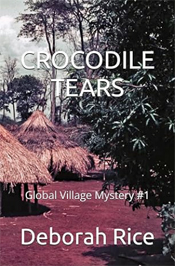 What is at the heart of the story you tell in Crocodile Tears?
The heart of the story of Crocodile Tears is the question: Can Hannah Craig, trainer of village midwives near a small town on a tributary of the Nile in Ethiopia, uncover the real cause of a young boy’s death and help a village heal, when ethnic friction compounds the tragedy? With it, at the heart of the story, are two deeper questions: 1) How to keep personal identity from wrapping itself around ethnic identity in a way that leads to ethnic friction, and 2) How can humans from different ethnicities work together to recover from a tragedy caused in large part by their differences?
Who are your main characters? Why did you choose them to carry your story?
You build characters who will embody and carry the threads of your themes and plot; and who —you hope!—will also live and breathe. I based all my characters on real people I knew in Gambela, or read about in real-life accounts, or whose writings and photos I’d researched online.
My central character is Hannah Craig, an Ethiopian-born American ex-missionary who is a window for American readers into Ethiopian cultures like the Anuak and Nuer. Her own inner conflict about whether she’s an American like her biological parents or an Anuak like the people she was raised among makes her deeply resonant on ethnic issues.
Other main characters, Omot (Anuak) and Gatbel (Nuer), I based on people I knew, worked with, and admired when I lived in Gambela. Mariam and Becca carry the drama of Hannah’s difficulties with her daughter and granddaughter. Hannah’s childhood women friends and fellow gardeners embody her lifelong attachment to the Anuak way of life. Solomon is the son of one such woman, twisted by his begetting onto a torturous path; still, Hannah refuses to believe he is unsalvageable. I have no idea where Wyatt came from, but, like Hannah, I found him just right!
Tell us about one or more of the main settings. What makes them the best place for the story to play out? Are the settings characters in the book?
The setting is Gambela, a small trading town on an Ethiopian tributary of the Nile, where I lived for a time and met my husband. It is absolutely a character in the book, as responsible as the local traditional gods for shaping the lives and characters of the people. To me, this is uniquely a story of Gambela; its sounds, smells, tastes, people, feelings, dramas, passions.
What challenges did you face in completing this first book in the Global Village Mystery series?
I’d never written a book in which the setting had such a deep personal meaning. It was of prime importance to me that I convey enough of the real lives of the people in this small town that it could have some small fraction of the impact living there had on me in opening my eyes and heart to my fellow citizens of the world.
The other challenge was learning how to publish on Amazon, then expanding my social media, which did not come naturally—until I applied my Gambela experience and realized it’s just talking to people, after all!
How did Crocodile Tears come together?
Three things came together to inspire this book and series. First, my life-changing time in Gambela. Second, the feeling, after writing several mystery novels, that I needed to get back to bedrock: a place I really know, a place I really care about, a place that embodies issues that are real and important to me, and that, by the way, is rich with elements that would make a mystery series compelling. Third, my growing concern with the ethnic and ideological intolerance that is increasingly tearing our nation and world apart.
The process took about five years. First, research to fill in holes on areas related to the specific plot. Then writing, rewriting, consultation with—truly terrific!—writing coach Sarah Lovett. Then talking to editors and agents at conferences, packaging and mailing requested proposals, doing requested rewrites. Then, finally, deciding to self-publish on Amazon, and learning the many new skills involved in being a publisher.
Did you discover anything surprising while doing research?
So many things. I never get tired of the new things I learn about subjects that already interest me. That’s one of the things that makes me sure I’ll never stop writing. Almost all of the things I learned reinforced that Gambela is, indeed, the Global Village I’ve long thought it to be, a capsule of the world and its issues in miniature, a perfect setting for a writer.
What was your favorite part of working on this project?
Mentally—and physically—revisiting Gambela and its people.
What themes do you explore in Crocodile Tears? How are they important to you on a personal level?
The importance of really seeing, understanding and cooperating with other people. This is a fundamental focus of my own life, and of Hannah’s. When this is absent, fixed attitudes can expand into interethnic intolerance and violence, leading to the kinds of tragedies we see proliferating around us in the world today.
Have you ever suffered from writer’s block?
Never! Writing is made up of many different types of tasks. They all need to work together to make a book. There is always something to do, someplace to start working: building the world, a character, finding new ways for the story to grow and branch out. Or, to put it differently: researching, plotting, writing scenes, rewriting scenes, rereading, rethinking, spinning ideas, talking to the characters, getting them to talk to each other, then exhaling and doing it all again.
What advice do you have for beginning or discouraged writers?
Write. Start something, anything. Start working on any part of it. Schedule regular times to work and let it build. The work and product itself will start to steer you.
What writing projects are you working on now?
Global Village Mysteries #2, Tigray Claws. Obviously, I’m hooked on Hannah and the rest of my people in Gambela. I’m now knee-deep in her next adventure, which is holding surprises even I didn’t expect!
Is there anything else you’d like readers to know?
If you’d like to learn more about me, my books, or my time in Ethiopia, check out my website, DeborahRiceWriter.com.
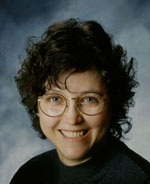 KL Wagoner loves creating worlds of fantasy and science fiction. Her current work in progress is The Last Bonekeeper fantasy trilogy and short stories in the same universe. A member of SouthWest Writers since 2006, Kat has volunteered as the organization’s secretary, newsletter editor, website manager, and author interview coordinator. Kat is also a veteran, a martial art student, and a grandmother. Visit her at klwagoner.com.
Leave a Reply