
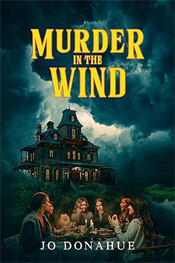
Author Jo Donahue (aka Dorajane Grummer) is a retired nurse turned author of romance, suspense, and cozy mysteries. Her 2025 novel, Murder in the Wind (Volume 1 of The Writers Club Mysteries), takes readers to an annual retreat with a group of writers, a killer hiding among them, and a hurricane trapping them all in a Victorian house where “the most dangerous thing might not be the hurricane, but the secrets carried on its winds.” Look for Jo on her website JoDonahue.com, on Instagram, and her Amazon author store.
 What is your elevator pitch for Murder in the Wind?
Murder in the Wind is a mystery about a mystery writer whose retreat takes a deadly turn. Marilyn Peters and her dog, Peppers, arrive at the Wine and Whine Writers annual retreat expecting a quiet gathering, but instead they find a mysterious diary, a looming hurricane, and the chilling realization that a killer is among them. At the heart of the story is one urgent question: can Marilyn uncover the truth before the murderer strikes again?
What challenges did this work pose for you?
When I write a book, I usually begin with the first chapter, then the last, and only after that do I create the outline. That helps me shape the story, so it builds naturally toward the ending I have in mind. The challenge with this book was finding the right balance between revealing information a little at a time and keeping the pace and suspense strong enough to pull the reader forward.
Peppers played an especially important role in making that balance work. Whenever the story became too intense, he brought in a moment of lightness that helped ease the tension without taking away from the mystery. He was not there simply for charm, though he certainly brings plenty of that. He also helps move the story forward and, in his own small but memorable way, proves to be quite the little hero.
How did you go from the premise/story idea to a mystery plot with clues and suspects?
I belong to several romance writers’ groups, but I realized early on that I am not a romance writer. My sons like to tease me that I have been a widow too long to remember how all that works. The idea for this story really began during a sprint group, when one of the members had just moved to Alabama and talked about how different hurricanes were from the droughts of California. Since we had all agreed to meet once a year, the idea started to grow from there.
The setting came together quickly: an older house, a hurricane, and a group of writers gathering each year. From there, all I had to do was build the mystery. Because I work from detailed outlines, usually 12 to 20 pages long, it was easier to place the red herrings and shape the suspense, even if I moved a few of them around to improve the flow. The characters, a lively group of writers, were inspired by a composite of people from my different sprint groups. That makes them feel familiar, and even a little recognizable.
Share a little about your main point of view character and why you chose her to tell the story.
Marilyn Peters is a mystery writer, which made her a natural choice to tell this story. Because she is used to building plots and planting clues, she is especially well suited to facing a mystery of her own. Everywhere she turns, she finds herself in situations that feel as if they came straight out of one of her books, except this time she is the one living the story. Having created red herrings on the page, she now must sort through them in real life and decide what is true. Peppers, her little dog, helps guide her back when she loses the trail, moving the investigation forward while also bringing warmth and heart to the story.
What is the main setting? Why is this place and time important to the story and the characters?
When I get bogged down as a writer, I often turn to a bit of comic relief. While I was writing this story, I had been watching The Ghost and Mrs. Muir and The Munsters, and I ended up blending those two houses in my imagination to create the setting. The result was an old Victorian house on a beach in Alabama, where I used to live—a setting that felt dark, atmospheric, and perfect for mystery.
The story would not have been as mysterious or compelling if I had set it in a modern house in Sacramento. I wanted the sense of unease to begin the moment Marilyn arrived at the bed-and-breakfast and realized it was nothing like the brochure. As the storm built outside and the house went into lockdown for the hurricane, the suspense grew even stronger because the characters could not leave. They were trapped and forced to find the killer before becoming victims themselves.
Tell us more about the book and how it came together.
Most of my stories are set in places I have lived before. My late husband was a hospital administrator, and our family moved about every three years. Before each move, I would immerse myself and the children in the history of the place we were going, and over the years I filled notebooks with descriptions and details. Now all that research is paying off.
I have always loved being on the beach just before a storm. The force of nature and the clean, fresh air have always drawn me in, and that atmosphere found its way into this book. As a new author, it took me two years to write it, and my poor sprint friends had to listen to plenty of my frustrations along the way. What I learned is that drafting is only part of the process—the real story often comes together during editing. I am grateful my group encouraged me to develop style sheets and story bibles, because without them, this book might never have been finished.
The cover was a challenge too. I worked with a Ukrainian cover designer, and because they were not familiar with the story—and were creating it while their country was at war—it took some extra collaboration to get it exactly right. Still, they were wonderful to work with and kept refining it until we were both happy with the result. One of the ways I motivate myself is by ordering the cover as soon as I have written the first and last chapters and completed the outline. I then set it as the background on my computer screen, so I see it every day. That image helps keep me focused and moving the story forward.
What was your favorite part of putting this project together?
Of course, the best part is writing “The End,” but outlining is a close second. Most of my sprint group are pantsers, and I still do not understand how that works. I am very organized and like to know where I am going before I start writing. A detailed outline keeps the story on track and makes the drafting process much smoother. That said, I can still change direction if something is not working, but I need that sense of structure. That comes from my many years as a nurse. Right now, I have six books outlined and ready to go, and I usually create the outline as soon as a story idea comes to me.
You began your fiction writing career later in life. What did your mature self bring to the writing table that your younger self never could have?
Up until about six years ago, I was busy living life. I had an active nursing career, raised three children, and sometimes I am not sure whether I was raising them, or whether they were raising me. Our family moved often, my children were nine years apart, and I stayed deeply involved in clubs and school activities. What I did not realize at the time was that all those experiences were quietly preparing me to become a writer.
I had always written in small ways, through little stories, diary entries, and personal reflections, but never with real seriousness until I began preparing for my doctorate. That was when writing became essential. I had always thought I could write well, but when I got my first paper back as a doctoral student and saw every page covered in red marks, I quickly realized how much I still had to learn. It had been twenty years since I had been in school, and I knew it was time to buckle down.
Now I carry all those years with me into my work. I have a storehouse of settings, the history of places, and characters inspired by people I have met along the way. I also bring the ability to look back at my mistakes and share those experiences honestly, so others know they are not alone in making them. In that sense, I think life has made my writing more human, and a little more compassionate too.
What inspired you to become a writer? When did you consider yourself a writer?
My father was a writer who created beautiful, warm stories and poems, and for a long time I never imagined I could do the same. Then, after attending a writing class, I went to work the next day and told my co-worker, Chuck, that I thought I might write a romance, and not just any romance, but a historical western romance, since I grew up in Oklahoma. He laughed and teased me about it all day, not in a mean way, but certainly enough to stir my competitive side. By the end of the day, I had decided I was going to write that book if only to prove him wrong.
I joined my local romance writers’ group, and with their patience and encouragement, I wrote the book, published it, and dedicated it to Chuck. He still gives me a hard time, but he does not laugh anymore. Even so, I did not fully think of myself as a writer until my short stories were chosen for the Hearts through History anthologies. That was the moment I felt I had truly found my place. At the same time, that first book also taught me something important: I am not really a romance writer. What I love most are stories filled with action, adventure, suspense, and mystery, especially those centered on strong women characters. Even now, I am writing first for myself, because I have so many stories I want to share.
What writing projects are you working on now?
I have several writing projects in the works right now. The first book in my Donna Thornberry series, Cherokee Cypher, will be published this month (June 2026). It follows a retired police detective who uncovers hidden clues in a quilt carried by the Cherokee people along the Trail of Tears from Georgia to Oklahoma. The story has a treasure-hunt feel, with caves in northeastern Oklahoma near Grand Lake adding to the adventure. Of course, it is also another murder mystery, since I do seem to kill off quite a few people in my books. Donna is a strong female character who knits while piecing together the clues.
My next book, Kabul Running, has been drafted and is now in the editing stage. It tells the story of a young graduate nurse who visits her diplomatic parents and becomes caught up in the evacuation of the United States from Kabul, Afghanistan. From there, she is swept into a high-stakes journey involving recovery from a car bombing, an effort to clear her mother’s name after she is accused of being a spy, and even the possibility of love along the way. It is full of adventure, kidnappings, and murder.
I also have another drafted book that is ready for editing, Miscalculated Love. It is a romance set partly in Los Angeles and partly on a wide-beam boat traveling through the canals of England.
Is there anything else you would like readers to know?
I think the clue to writing is to find out what you really like to write. Writing to impress or writing just to sell books is really difficult. I write my stories because I like these kinds of stories. I am always glad when others write to me and tell me that they like a story or ask questions about my stories. It is important to study your craft. Does it mean that I follow what others say, or write perfectly? No, you take what helps you and discard the rest. There is no perfect writer. Stop striving to be perfect and just tell your story.
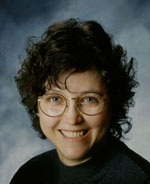 KL Wagoner loves creating worlds of fantasy and science fiction. Her current work in progress is The Last Bonekeeper fantasy trilogy and short stories in the same universe. A member of SouthWest Writers since 2006, Kat has worked as the organization’s secretary, newsletter editor, website manager, and author interview coordinator. Kat is also a veteran, a martial art student, and a grandmother. Visit her at klwagoner.com.
Leave a Reply