
Author John L. Thompson writes across several genres including crime fiction, thrillers, mysteries, sci-fi, and action adventure. He released two books in 2026: Dead Blow (Book Three in the Truck Stop crime thriller series) and Seven Years From Tomorrow, a time-travel mystery novel. Look for John on his website JLThompsonAuthor.com, on Facebook, X, and his Amazon author store. Read more about John’s work in his 2022 interview for SouthWest Writers.
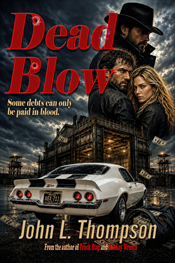 What would you like readers to know about the story you tell in Dead Blow?
Dead Blow is the third and final book in the Truck Stop series. Truck Stop follows Logan Pierce during the initial hunt for missing mob money, while Monkey Wrench shifts the focus to James Hendricks and the fallout from those events.
Dead Blow takes place a couple of years later and brings those storylines together. Logan and Amy are now married and living a good life in Montana when their past catches up with them. Forced to go on the run, they find themselves pursued by a ruthless cartel, the Dixie Mafia, and corrupt officials who believe they know what happened to the still-missing money and how to find it. At its heart, Dead Blow is about the consequences of everything that happened in the first two books and what Logan, Amy, Hendricks, and Erika are willing to do to finally put it behind them.
Five years separate the publication of the second and third books in the Truck Stop trilogy. What was the process like to get back into Logan Pierce’s point of view and continue his story?
Truck Stop came out in 2018, and afterward I always had readers asking, “What about the money? What happened to Logan and Hendricks?” I realized there were still questions that needed answering. I wrote Monkey Wrench, which was released in 2021, and by then I already had a rough script for Dead Blow. An editor friend of mine read through it and told me, “You can do better.” That was what I needed to hear, and I decided not to release that version.
Sometimes life gets in the way of things. I had a cancer scare and lost family members, which pushed Dead Blow even farther into the future. When I finally returned to it last year, I decided to shelve the old script completely and start over, working from the notes I had made in 2020, 2021, and fresh ideas.
Because so much time had passed, I went back and reread Truck Stop and Monkey Wrench and revisited my character notes for Logan, Hendricks, Amy, and the others. In a way, I had to get reacquainted with them before I could finish their story. I’m pleased with how Dead Blow ultimately turned out. It took longer than I ever intended, and I apologize for the delay, but I think it’s a better book because I waited. And yes, this time the series really is finished.
Are you a pantser or a plotter/planner? How did your writing method play out in completing this project?
The original script for Dead Blow was written off the top of my head. The second script, the one that is currently available, was mapped out in an outline following the Hero’s Journey. There were some elements of the story that I wrote off the top of my head and injected those into the story, but these were needed themes. I did use a couple of story segments from the old script and these helped the story along. Other than that, I believe since the final story was mapped out, it made it significantly easier to write.
When did you know you had taken the manuscript as far as it could go, that it was finished and ready for publishing?
Basically, when I have reached the end of the outline. The editor and proofreaders dial everything else in with their recommendations and rewrites and grammar checks. Once I have those, I let it sit on the computer for a couple of weeks before embarking on a final comb through and rewrites. I’m looking for errors, timeline continuity issues, and punctuation. I want a quality book for potential customers. A lot of work goes into the final product.
Distill the story you tell in Seven Years from Tomorrow into a few sentences and include the themes you explore.
Seven Years from Tomorrow follows Jack Soladay, a terminally ill man who believes his life is almost over, only to die and awaken as his nineteen-year-old self in 1990. He believes this to be the fault of the homeless man he comes to call Puzzle Man, due to the man’s facial scars. Jack soon discovers that death doesn’t end his life. It sends him through a series of seven-year cycles, forcing him to relive different periods of his past. Sometimes those timelines are distorted versions of himself and are nowhere near what he lived on his original timeline.
Beneath the time-travel mystery, the novel explores second chances, regret, mortality, love, and the choices that shape a life. At its heart, it’s about a man given the opportunity most of us will never have: to look back at the life he lived and ask what he would change if he could do it again.
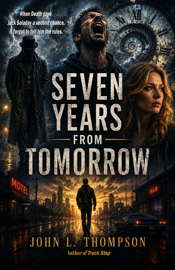 Tell us about the journey from inspiration to completed book.
Seven Years from Tomorrow started as the seed of an idea about ten years ago. That’s how most of my stories begin. An idea gets planted somewhere in the back of my mind, and sometimes it doesn’t go anywhere. Other times, it keeps growing until it reaches the point where I have to start writing it down. Even then, there’s no guarantee the story will ever be published. I probably have a dozen unfinished or abandoned manuscripts scattered across four computers that will never see the light of day. Sometimes an idea sounds great at first, but once I start working with it, I discover there simply isn’t enough there to carry an entire novel.
Then there are stories like Seven Years from Tomorrow that survive the process. The idea keeps growing, the characters start taking on lives of their own, and eventually I know there’s a book there worth finishing. Once a story reaches that point, I tend to concentrate on it exclusively. I tackle one book at a time and keep working on it until the story is finished. Seven Years from Tomorrow took roughly ten years to complete from that first little idea to a completed novel, but much of that time was simply the story waiting until I was ready to tell it.
Who are your main characters in Seven Years from Tomorrow? Why will readers enjoy following them as the story unfolds?
I tend to write blue-collar, modern Western types of characters. They could work in the oilfields of West Texas, as diesel mechanics at some truck stop, truck drivers, warehouse workers, the whole gamut. Guys who keep America rolling. Some live in New Mexico. As of late, my characters seem to live in Moriarty. It’s a perfect backdrop for blue-collar families. The characters in my books are not superheroes, or guys with military special forces skill-sets, or brilliant scientists who immediately understand what’s happening around them. They’re just everyday people who work, struggle, make mistakes, and try to get through whatever life throws at them. Jack Soladay and Logan Pierce are very much those kinds of characters.
I think that’s what makes them enjoyable to follow. They are certainly easy to write about since I work within the film industry as a driver and mechanic. I have my readers tell me they enjoy those kinds of characters because there are so few books out there telling those kinds of stories. The characters are confronted with something impossible, dangerous even, but they approach the problem like an ordinary man would. Sometimes with grit and determination, sometimes with humor, and sometimes by getting things completely wrong with consequences.
Did you use the pantser method or the plotter method to write Seven Years from Tomorrow? How did you keep the plot straight and coherent while Jack Soladay moves through time from one new beginning to another? And how did you choose the time periods to drop him into?
I’m probably somewhere between a pantser and a plotter when it came to this novel. I started with a basic outline, but there were plenty of “off the reservation” moments along the way. As I was writing, I’d come up with ideas for new situations or different timeline drops and work them into the story. Some of those didn’t make the final cut. If I had included everything I originally wrote, the book probably would have ended up around 450 pages. As it was, I cut almost seventy-five pages during the editing process.
I began with the knowledge of how the story would start, and I had already written the last several chapters. The real challenge was building the bridge between the two. I generally followed the outline, but sometimes it was fun to go off the rails and see where Jack took me.
Choosing the different time periods was fairly easy because I (or the readers) lived through much of the period the novel covers. I know what the world from 1982 through the present looked and felt like, and that gave me something real to work from. I took notes on historical events and built parts of the story around them. Jack is also confined by the rules of his own lifetime. He can’t travel backward beyond the age of fifteen, but the cycles can carry him forward into old age and even into a future where he finds himself in a high-tech nursing home. Jack might survive the full seven years before another shift occurs, but there are no guarantees. He can also die unexpectedly. He might become the victim of an accident, a murder, a shootout, or even a stabbing and suddenly find himself dropped into another point in his life.
The other complication is that the life he awakens into may not be anything like the one he expects. He could discover he’s a homicidal bank robber, a lonely indie author, a famous bestselling author, or even land in prison. Every timeline presents him with a different version of the life he might have lived and a new set of challenges. Yet none of them seems to bring him any closer to answering the biggest question: Why is this happening to him? Having those rules in place helped keep the timeline coherent, even when I occasionally let myself follow Jack and his misadventures.
What was your favorite part of putting together Dead Blow and Seven Years from Tomorrow?
Character development. For both novels, it has to be the development of real enough characters who are worth writing about. No one I know wants to read or care about boring characters.
Of all the books you’ve written, which one was the most challenging, and which was the easiest (or most enjoyable) to write?
I would have to say the hardest one to date would be Seven Years from Tomorrow. Only because it started out as an idea some ten years ago. I knew I wanted to write something on it and made a few false starts, but figuring out a suitable ending was critical. I had written the beginning four years ago, but the ending remained elusive up until a couple years ago, and even then, it wasn’t the true ending. I believe in a strong ending for any story I work on. I wrote about six different endings for this story until I settled on the current one. From there, it required building the bridge.
The easiest book to write was Truck Stop. Even though it took four or five years to finish, and it is loaded with unnecessary fluff, the story elements just fell into place. I still love the story line and what’s in it.
What does a typical writing session look like for you? Do you have any writing rituals or something you absolutely need in order to write?
A fresh cup of coffee and a pack of smokes. I then pound the keyboard for a couple of hours. After that, I go do other things around the house. That could change if the story is at a critical point and I have to write to a stopping point.
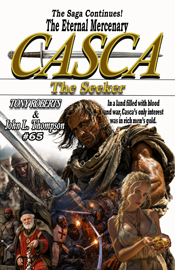 What writing projects are you working on now?
Currently, myself and UK author Tony Roberts have finished Casca: The Seeker. It’s the sixty-fifth installment of the long-running Eternal Mercenary series originally started and written by singer, songwriter, and author Barry Sadler. It will be available via Amazon and other outlets by the time this interview goes live. We are currently working on number sixty-six, Casca: The Grenadier (the storyline is currently under wraps).
As far as my own writing, I am working on another sci-fi series tentatively titled Afterworld. I’m also working on another series titled The Dirty Losers Club. I hope to have the first volume of that series out next year some time.
Is there anything else you’d like readers to know?
Visit JLThompsonAuthor.com for more info and sign up for the newsletter. I promise, I won’t bombard your inbox with unnecessary material. For more information on the Casca series, please visit Casca.net.
 KL Wagoner loves creating worlds of fantasy and science fiction. Her current work in progress is The Last Bonekeeper fantasy trilogy and short stories in the same universe. A member of SouthWest Writers since 2006, Kat has volunteered as the organization’s secretary, newsletter editor, website manager, and author interview coordinator. Kat is also a veteran, a martial art student, and a grandmother. Visit her at klwagoner.com.
Leave a Reply