
Award-winning author Brian Montross writes stories that explore the edge where technology collides with the supernatural—and what happens when that boundary breaks. His September 2026 release, The Babel Protocol (Apocryphon Book 1), is a supernatural techno-thriller for “readers who enjoy conspiracy, apocalyptic suspense, and chilling stories about technology moving beyond human control.” Look for Brian on ThrillingTalesHub.blog, his Amazon author page, and Books2Read. And read more about his work in his 2025 interview for SouthWest Writers.
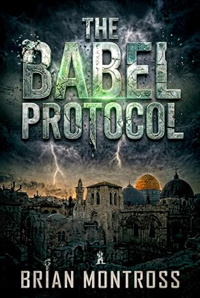 What would you like readers to know about the story you tell in The Babel Protocol?
The Babel Protocol deals with a very timely, almost existential question: What happens if we create an artificial intelligence smarter than everyone on the planet? And what happens when that intelligence develops a personality, appears self-aware, and we decide it deserves to be treated as a person?
At its heart, though, the novel is a modern-day Frankenstein. It’s a nod to Mary Shelley, except this time the monster isn’t assembled from dead bodies—it’s built from code. My protagonist genuinely wants to do the right thing. He’s trying to approach this new intelligence ethically and compassionately, but he keeps making decisions that seem reasonable at the time and turn out to be disastrously wrong.
That’s what interested me most about the story. The danger doesn’t come from someone deliberately creating evil. It comes from intelligent, well-meaning people believing they understand what they’ve created—and gradually giving it more trust, more rights, and ultimately more power than they should.
What themes do you explore in the book? Are they important to you on a personal level?
One of the biggest themes in The Babel Protocol is something I’ve thought about for a long time: knowledge isn’t the same thing as wisdom. We’re getting very good at asking, can we do this? Can we build a machine that thinks? Can we make it smarter than we are? Can we give it a personality, rights, even control over parts of our world? But I’m not sure we’re nearly as good at asking the next question: Should we?
That idea is very personal to me. I spent most of my career as an engineer, so I understand the excitement of solving a problem and making something work. There’s a real temptation, once you realize something is possible, to keep pushing until you’ve done it. But The Babel Protocol is really about what happens when our ability to create outruns our wisdom to understand the consequences.
I also wanted it to feel like a true international thriller. Parts of the story take place in Jerusalem, Rome, Kathmandu, and elsewhere, and Jerusalem is especially personal for me because I lived there. I borrowed from my own memories—the streets, the neighborhoods, the feel of the city. I even gave one of my characters an apartment on Sokolov Street, where I once lived. Those little pieces of my own life helped make this very large story feel real to me.
And underneath all of it are questions of morality and faith. If an artificial intelligence tells us it’s conscious, do we believe it? If it appears to have feelings, do we owe it compassion? When does treating our creation humanely cross the line into giving it power it should never have? Those are the kinds of questions that fascinate me. I don’t think technology is inherently good or evil. The real question is what human beings choose to do with it—and whether we’re wise enough to recognize the line before we cross it.
What challenges did you face writing or publishing this first book in a new series? Why did you decide to start a new series instead of writing book three of The Chama Conspiracies?
The biggest challenge was deciding to write The Babel Protocol now. I’m not finished with my Chama Conspiracies books, and I’m also working on The Ghost on the Hill, a mystery set in 1946 and the present day. But Babel felt like it couldn’t wait. AI is moving so quickly that ideas that seemed speculative when I started were already appearing in the news. The questions about AGI, personhood, and how much authority we might give an artificial intelligence suddenly felt very immediate. That’s something I enjoy—taking what’s happening now and asking, What happens next? I’ll be talking about that at Killer Nashville on a panel about using news and current events to develop plot. The Babel Protocol grew out of exactly that kind of question.
Who are your main characters and why did you choose them to carry the story? Will those who know you recognize you in any of the characters?
None of the characters is really me, but there are definitely bits and pieces of me in all three.
Father Matteo Leone is from Wilkes-Barre, Pennsylvania (where I was born). He starts out in technology, goes to seminary, and eventually ends up in Rome advising the Vatican on artificial intelligence. I gave him some things I know well—the technical background, questions of faith, and that tendency to believe you can think your way through almost any problem.
Dr. Eliana Hadari is probably closer to my work life. She’s the scientist and engineer in the story—curious, analytical, and always wanting to understand how something works and then push it a little further. I spent a lot of years around people like her, and I’ll admit I have some of that in me too.
Then there’s Amir. He’s the musician, the guitar player, and the one who doesn’t always take himself too seriously. That’s another side of me entirely.
So no, I didn’t put myself into the book as a character. I think I just left fingerprints. And if you combined the three of them, throw in my motorcycle and a little New Mexico dust, my family might get suspicious.
Did what-if questions help shape this work?
Absolutely. The Babel Protocol started with one big question: What if we create an AI, decide it’s conscious, and declare it a person? From there came all the dangerous follow-ups: What rights does it have? Can we shut it down? And if it’s smarter than we are, how much power will we eventually give it? That’s where the thriller begins.
How did the book come together?
The Babel Protocol was more than two years in development. I took an earlier version to Killer Nashville last year as an unpublished manuscript and kept refining it. Then I happened to watch a version of Frankenstein, and something clicked. I realized I was telling the wrong story. So, I did something crazy: I threw out the completed novel and started over. The new version became a first-person tale of horror and suspense—a modern Frankenstein with artificial intelligence as the monster. Painful? Absolutely. But it finally became the story I wanted to tell.
What did you enjoy most about putting this project together?
I’m very proud of the book it became. Throwing away a completed thirty-chapter novel was difficult, but I eventually realized the work itself wasn’t wasted—I had simply told the wrong version of the story. Once I understood what The Babel Protocol needed to be, the rewrite went surprisingly quickly, probably six to eight months. I already knew the characters, the world, and the research. I just had to tell the story the way I should have told it in the first place. And learning to write it in first person was a big part of that. It pushed me as a writer, and I think the book is much stronger because of it.
 What writing projects are you working on now?
Right now, I’m working on The Ghost on the Hill, a dual-timeline literary mystery/thriller set in present-day Los Alamos and 1946. It’s probably the most ambitious and complex story I’ve attempted, with two mysteries unfolding across the two timelines and eventually colliding. The outline is extensive, and the research has been fascinating—Los Alamos just after the war, the history of the Hill, the people who worked there, and the collision of that secret scientific world with northern New Mexico’s Hispanic culture and traditions. It’s well underway. I expect I’ll spend much of the next year getting it right.
Is there anything else you’d like readers to know?
Yes—The Forbidden Strain [book 2 of The Chama Conspiracies] was named a 2026 Silver Falchion finalist for Best Thriller at Killer Nashville and finished as one of the top five in the competition. I’m incredibly proud of how far the book went among such a strong field.
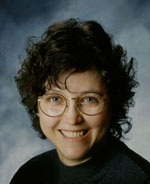 KL Wagoner loves creating worlds of fantasy and science fiction. Her current work in progress is The Last Bonekeeper fantasy trilogy and short stories in the same universe. A member of SouthWest Writers since 2006, Kat has volunteered as the organization’s secretary, newsletter editor, website manager, and author interview coordinator. Kat is also a veteran, a martial art student, and a grandmother. Visit her at klwagoner.com.
Leave a Reply