
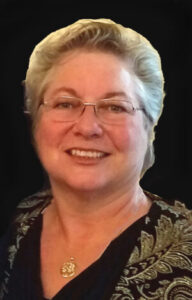
Rose Marie Kern is a retired air traffic control FSS specialist and an award-winning author, as well as a speaker and teacher, Master Gardener and solar chef, and an active member of SouthWest Writers (SWW). She has published several nonfiction books, over 1,000 articles on various topics, plus short fiction and poetry. And as part of her volunteer work for SWW, Rose often wears editor and formatting hats to help produce the organization’s annual anthologies.
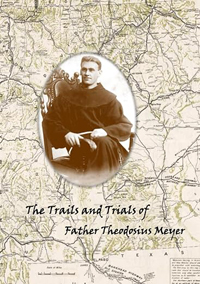
In 2025 she edited and published The Trails and Trials of Father Theodosius Meyer, a memoir written by family member Fr. Theodosius who, for almost forty years, “strove to understand a wide diversity of cultures and languages in order to provide spiritual guidance to remote Catholic missions” in early 20th century New Mexico. You’ll find Rose on her SWW author page and her Amazon author store. Read more about Rose’s work in her 2017, 2019, and 2020 interviews for SouthWest Writers.
 What would you like readers to know about Father Theodosius Meyer and the memoir he wrote?
Frank Joseph Meyer was born in 1882 in an Indiana farmhouse. His Dad taught him a myriad of skills a man of that era would need: carpentry, growing crops, fishing, and hunting. The family was deeply religious and Frank began thinking about becoming a priest from a young age. His father died when he was 15 years old, so he became “The Man” of the family. But his mother and uncle knew he truly wanted to devote himself to the church, so when his younger brother, Leo, came of age, he took over the farm and Frank was encouraged to join the Seminary.
In the Catholic tradition, when someone enters the Novitiate for training, they take on a new name to signify their commitment to God. When Frank put on the Franciscan robes, he became Father Theodosius. You never know where the church will eventually send you, or what your duties will include, but after he was ordained into the priesthood, Fr. Theodosius was sent to a place he’d never heard of, very far away from the rolling cornfields of Indiana.
In July of 1914, Fr. Theo entered service in the newly minted state of New Mexico. The memoir he wrote goes beyond his personal observations and becomes a window into the history and cultures which molded this wild western territory into the unique blend we know today.
This project began as a preservation of your family’s history, put together for them to cherish into the future. Have you found a wider audience for the book beyond family?
Fr. Theo began his career here as a caring missionary, but over time his skills and knowledge advanced him into a larger socio-political arena. He served as a priest to over 25 communities in his time. He was Chaplain to the New Mexico State Senate, and the Chairman of the annual Santa Fe Fiesta. He was influential enough to have enemies, and was shot one day while fishing. He advocated for better roads in rural communities and was assigned the job of re-modeling the famous St. Francis Cathedral in Santa Fe.
What was the process like to get the original typewritten manuscript into a format you could use to publish the book?
The manuscript I was given by Fr. Theo’s nephew was typewritten with many things crossed out and others corrected by hand. It was impossible to simply scan into an editable .pdf. I opened up a blank document in MS Word and used the “Talk to Text” feature. Then I simply read the manuscript aloud from beginning to end. Once it was in print, I was able to manipulate the formatting.
Give us an example of the type of editing you did for the memoir.
Unsurprisingly, things have changed in the last hundred years, so there were portions of the text that needed explanations — which I provided as footnotes in the manuscript. Additionally, I did research about the era and the places Fr. Theo worked — so I’ve included photos of some of the churches he served, and photos of him which were provided by his nephew, Leo Meyer.
Were you surprised by any aspect of the project as it unfolded? Did it meet your expectations?
There were many surprises as I married Fr. Theo’s insights to New Mexico history. He wrote articles for local newspapers, and was the subject of others. I was able to retrieve some of these on the internet and included them in the book.
Tell us more about how the book came together.
The original manuscript was handed to me by my mother’s cousin, Leo Meyer, during my visit to Indiana in 2024. Being an avid collector of family lore, Leo was able to provide me with many of the photos of Fr. Theo in the book. It took about a year to complete the project after I’d gathered the peripheral information I felt was needed, including verification of the dates Fr. Theo mentions concerning his career – this required contacting the Archdiocese of Santa Fe and Indianapolis. Once I had it all gathered, I determined the printing/distribution channels I wanted to use, the size of the book itself, the typeface/styles and the message I wanted to convey with the cover art.
What was the most surprising thing you discovered while reading the story or doing research for the book?
I work with many authors, including one who writes about scandalous women in the old west. Donna Pedace wrote about a wealthy, famous gambler, Dona Tules, who was purported to have been buried under “a church” in Santa Fe in 1852, but no one remembered where.
In 1939 the ceiling of the St. Francis Cathedral in Santa Fe began to crack, so the church called Fr. Theo in to look at it. He discovered that the large pillars holding up the roof were tilting. Over the next few years, he headed a workgroup to rip out the floor of the church and stabilize the ground below. In the process they found 30 unmarked coffins buried underneath. Turns out the cathedral had been built on the site of an older church, and it was common practice in the past for wealthy patrons to be buried under the floor of churches. These coffins were dug up and reburied in the cemetery. There is nothing specifically indicating that one of these was Dona Tules, but it was interesting how working on this book brought the possibility into my imagination.
What was your favorite part of putting this project together?
The look of delight on the faces of my mother and her cousin, Leo, when I handed them the final manuscript. Obviously, I’ve also gifted copies to the historical museums of all the towns and churches Fr. Theo worked for — and am delighted by their responses.
Your writing takes many forms — fiction and nonfiction, essays, articles, short stories, memoir — as well as poetry. Is there one form you’re drawn to the most when you write or read?
I’m addicted to “words” in just about any form, I’m personally most comfortable with writing essays, short stories and non-fiction articles. I love reading novels, primarily sci-fi/fantasy, mysteries, and historical fiction.
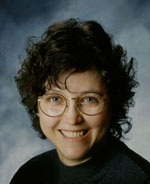 KL Wagoner loves creating worlds of fantasy and science fiction. Her current work in progress is The Last Bonekeeper fantasy trilogy and short stories in the same universe. A member of SouthWest Writers since 2006, Kat has worked as the organization’s secretary, newsletter editor, website manager, and author interview coordinator. Kat is also a veteran, a martial art student, and a grandmother. Visit her at klwagoner.com.
Leave a Reply