
Though Joyce Hertzoff and RJ Mirabal came to writing from different paths (hers as a science professional, his as an English teacher), they both ended up in the same place—the fantasy genre. This shared passion brings them together at SouthWest Writers (SWW) meetings, in critique groups, and as table-mates at local and regional book events. And they’ve both been hard at work on new writing projects since their first SWW interviews several years ago.
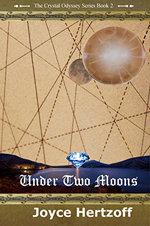
The Crimson Orb (2014), the first book in Joyce Hertzoff’s Crystal Odyssey Series, follows teenager Nissa and her older brother Blane on a journey to find her missing magic teacher, the wizard Madoc. The quest entangles them and a band of new-found friends in a search for the legendary Crimson Orb. The series continues in Under Two Moons (2017) with Nissa and the group searching for the source of Madoc’s strange books. After uncovering secrets about Nissa’s world, she and the others start on a path to recreate their history’s lost crystal-based technology. Joyce’s newest series begins with A Bite of the Apple (a Portal Adventures book, 2016) and another strong female character eager to find a place in her world. Anabet “Bet” Haines jumps at the chance to explore unknown lands as a portal traveler. When disaster strikes, and Bet is unable to finish her portal training, she is forced to accept an assignment to find a thief hiding in the strange, new world of The Big Apple.
 You’re in the middle of writing two fantasy series. Do your characters surprise you as you write their stories or do you rein them in and make them behave?
In both series, my main characters changed and grew because of their experiences. How that affected their world view and self-confidence surprised me a little. Nissa, the main character in the Crystal Odyssey Series, has gotten past her desire to do “what the boys do.” Now that she can wield a sword and do magic, and also learned how useful sewing and cooking can be, she realizes every lesson in life is important. She’s also traveled far from her insular early life at the duke’s manor and discovered the astonishing history of her world. Bet (from A Bite of the Apple) began her first trip through a portal with little training, only her wits, four enchanted apples, and a small knife. Now she’s gained experience and shown her abilities.
What was the most difficult aspect of world building for your books?
Neither of my main characters is particularly religious, but I had to come up with beliefs for some of the people they meet during their adventures. That wasn’t easy, especially since I didn’t want the religions to mirror those in our world. Similar to that, they meet many different kinds of people. I had to find a way to differentiate them all.
How has your writing style changed since you wrote your first book? What important lessons have you applied to your writing?
I don’t think my writing style has changed too much, but based on classes I’ve taken, books I’ve read, and especially critiques/feedback I’ve received, I’ve been able to break some habits (such as beginning sentences with “and” and “but”). I know now that I should include more descriptions than I did at first, and also show more of the characters’ emotions.
 Your stories place female characters in challenging predicaments. Do you work from an outline (plotter) to craft your stories or write by the seat of your pants (pantser)?
Pantser all the way. I’ve tried to use outlines. Every time I’ve abandoned what I intended when my characters picked different paths. I know an outline would help me with plot and scene structure, but I’d rather impose those after the story is done. I usually start with a plot idea but rarely know how the story will end. It’s more fun that way. It’s amazing, in a way, since I tend to think logically, in a straight-forward line.
Since the last SWW interview in 2015, a new sub-genre of speculative fiction has become popular — science fantasy. Tell us how your stories fit in this genre.
I could talk about genres all day. I thought my stories were fantasies with scientific overtones, but as they went along, science took over. I guess I needed a logical explanation for the magic without it taking away from the fantasy aspect. In the Crystal Odyssey series, there’s energy all around, more or less, and the magic the characters learn is the ability of using their minds to use this energy. But crystals can also be used to focus the energy and that’s what was used for technology in the past. In the Portal Adventures series, the keys necessary to pass through the portals can be anything, but substitutes can be made by enchantments. No one knows how the portals work, or the keys for that matter, but in the second book I’m working on now they begin to question and study both.
I’ve been told my books are for a Young Adult audience, since my main characters are eighteen; I can accept that if that includes coming-of-age stories. I never thought of them in those terms, but as I analyze the themes in each, that’s what they are.
 How are you coming along with Beyond the Sea, the third book in the Crystal Odyssey series? Do you have other projects you’re working on?
I’m doing the fifth or sixth edit on Beyond the Sea and trying to cut it from the initial 135,000 words to something more reasonable (now at 129,000 words). Each time I think I can cut a particular chunk from it, I realize how important that chunk is to the overall story. I’m also working on the sequel to A Bite of the Apple (called Winds of Change) as well as two near-future apocalyptic/post-apocalyptic stories (Addie’s Exile and The Train to Nowhere Somewhere). I’m also looking for places to publish two children’s stories: So You Want to Be a Dragon and The Ogre and the Two Sisters.
Read more about Joyce and her fantasy series in part one and part two of her 2015 interview, and connect with her on Facebook and Twitter, as well as HertzoffJo.blogspot.com and FantasyByJoyceHertzoff.com.
RJ Mirabal’s first book in the Rio Grande Parallax series, The Tower of Il Serrohe (2012), follows a disheartened and cynical Don Vargas through a portal into an alternative existence in the Valle Abajo (a place both alike and unlike his own Rio Grande Valley) where he takes on a quest to save the Valle clanspeople from the wily Soreyes. Extreme Dust Storms May Exist (2015) is the second book in the series that picks up five years after Don’s disappearance through the portal. The story follows his sixteen-year-old cousin Esther on a new quest against the Soreyes. In Zero Visibility Possible (2016) the Soreyes continue heaping terror on the clanspeople while Esther leads a group of comrades across the barren Malpais in search of answers to the mysteries of the Valle.
 Of the three books in your series, which was the most difficult to write and which was the easiest?
Tower, the first book, was the hardest because I had to establish the world of the Valle Abajo: what it looks like and how it differs from the New Mexico we know; how the magic works there (more complicated and subtle than the “you can do anything with magic” approach of standard fantasy); the various storylines and how they intersect; establishing the identity of the clans of the Valle; and…where do I take this story? How do the characters and plot develop along the lines of my major themes? Once that was done, books 2 and 3 fell into place. Book 3 was the easiest to write because the arc of the plotlines in the first two books were already well on their way, so it was fun to work out how it all ends. I had a couple of alternative endings, but I went with what felt right and satisfying for me as well as what I hoped my readers would both like and find surprising.
Tell us about some of the new characters introduced in books 2 and 3 of the Rio Grande Parallax series.
Esther is a bright, enthusiastic honor student and athlete drawn through the Portal into an alternate world. Though inexperienced in warfare and diplomacy, she believes she can help the Valle clans fight the evil Soreyes. Markey, her life-long friend, helps Esther pass through the Portal. He entertains romantic thoughts concerning her, but keeps them to himself—barely. Donald is the nasty leader of a clan of outcasts in the heights of the Mountains of the Sky who threatens the clans of the Valle. Ramon seems to be an abnormality in the rather peaceful healer/counselor Pirallts clan. He proves to be quite irritating to other characters. Scarflue, a minor character in the first book, becomes the major foil in books 2 and 3 as the crafty and evil leader of the revived Soreyes.
 Why did you choose New Mexico as the setting for your series?
The main reason was to allow me to break my story out of the typical mold of the Medieval European-type fantasy setting. This also allowed me to establish new kinds of characters and races not found in usual fantasy stories (dragons, elves, dwarves, etc.). Finally, there’s so much about New Mexico that makes it a wonderful setting for a fantasy: magical sunlight, high desert, Rio Grande River valley and bosque, lava fields, and tall mountains. We also have diverse cultures and an enchanted (pun intended) atmosphere that’s ideal to spark the imagination, especially for me being raised here from infancy.
What are the hardest kinds of scenes for you to write?
Action scenes are fun, but challenging because they must seem spontaneous and believable. It’s easy if your main characters are powerful, but when they’re not, how can they survive, either immediately or eventually, and still be believable? If they can’t, how do you handle the demise of a main character that might be beloved by readers (and the writer!)? Exposition is hard too, because those passages can be deadly boring and slow down, or stop, the pace of the story. Yet, you need exposition from time to time. If it has to be inserted in the middle of more interesting events, will it deflect the thrust of the scene/plot?
What is the best compliment you’ve received as an author?
When a reader is blown away by a big surprise or reveal in the story. I love when it works, so those compliments have been the most satisfying. Also when people “get” Don and don’t think of him only as a loser/jerk.
 What writing project(s) are you working on now?
A rather modest little story of a rescued dog—Trixie—adopted by an older couple who discover all her doggy nature and personality as they make her a part of their family. At a certain point, fantasy will be brought into the story through her dreams. The story is intended for “children of all ages,” especially for adults to read to little children. I have some ideas to create short videos to accompany the book, so we’ll see how that goes. I’m also hoping to record more videos where I read portions from my current trilogy to post on YouTube as a way to promote my work.
Is there anything else you’d like readers to know?
I’m thrilled and humbled to announce that my third book, Zero Visibility Possible, is one of four finalists in the 2017 New Mexico/Arizona Book Awards, Science Fiction/Fantasy category. My first two books were also finalists in 2013 and 2016, so I hope the third one is a charm and that it wins its category!
Read more about RJ and his fantasy series in his first interview for SWW, and connect with him on his website RJMirabal.com.
 KL Wagoner (writing as Cate Macabe) is the author of This New Mountain: a memoir of AJ Jackson, private investigator, repossessor, and grandmother. She has a new speculative fiction blog at klwagoner.com and writes about memoir at ThisNewMountain.com.
